

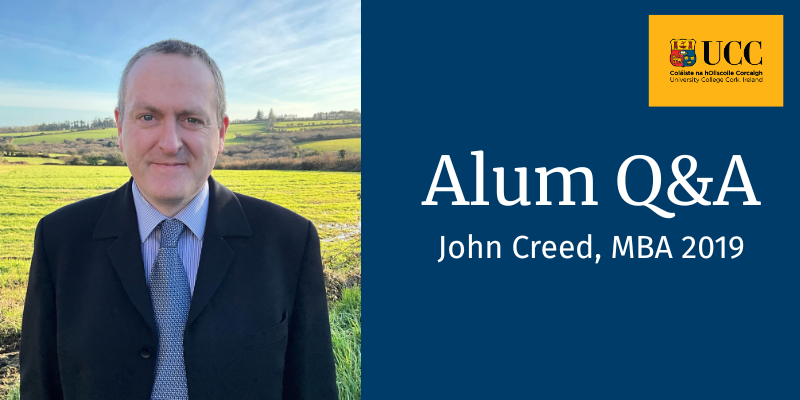
With nine patents granted in the last year, MBA graduate (2019) John Creed has merged his technical expertise with his UCC CUBS Executive MBA learnings to create solutions for mission critical, technical architectures.
John is a Senior Embedded Software Engineer with Motorola Solutions.
We recently caught up with John to find out more.
Before we get into the detail of your latest patent, tell us about your career history.
“I grew up in an entrepreneurial family in Limerick. My mother ran a grocery store my grandfather established, and my father ran his own business as an agent for Dairymaster. That spirit was instilled in me, and I was always determined to be an entrepreneur.
I started my technical career after studying Electronic Engineering at SETU and Microelectronics at UCC.
I then joined EMC (now Dell), where I spent 19 years. I progressed through several roles there, from Product Engineer to Subject Matter Expert, and then into the area of software development.
This move was crucial, because it gave me the technical skills to build solutions, which I could now combine with my deep, front-line understanding of what needed to be solved.
It was this synthesis of customer-facing crisis management and software engineering that became the foundation for my innovation work.
I developed a passion for innovation, particularly around issues with the highest criticality and economic cost.
I’m delighted to say that I've had nine patents granted in just over the last 12 months alone, all centred on high-value business problems.
I now work at Motorola Solutions and hope to replicate my success here.”
What brought you to do the UCC CUBS Executive MBA?
“My path to the MBA was driven by my long-standing passion for business, finance, and entrepreneurship.
I really feel the MBA has been the key to unlocking the true value of my experience.
I had 20 years of insight from two very different worlds. The front-line "customer pain" world and the technical software development world.
I knew the problems were massive and costly, but I needed a framework to move from just fixing symptoms to addressing the systemic cause.
I chose the UCC CUBS Executive MBA because I wanted to learn the language of business strategy. I wanted to learn more about systems that could identify and quantify customer pain points and consequent economic significance.
My technical skills showed me what was broken and my front-line experience showed me why it mattered. The MBA then gave me the strategic and financial tools to prove how much it mattered and to articulate a solution in terms of business value, customer retention, and develop a tangible and durable competitive advantage.”
Tell us about your latest patent and the rationale and process around it. What is it? What was the impetus for developing it? What problems will it solve? What solutions and value will it create?
“The patent is US 12,333,293, "Online update compatibility verification prior to update implementation".
At its simplest, it’s an intelligent "pre-flight check" for software, hardware and configuration updates. It’s a centralized cloud architecture that mandates every system "dial-home" before an update can be applied.
It uses machine learning to check the system's specific configuration against a global "Update Compatibility Databank" of known issues. If it detects an incompatibility, the update is unequivocally prohibited, and the system is never taken offline.
When you think about "mission-critical" systems run by hospitals, emergency services, or transportation networks, for example, downtime isn't just an inconvenience. It's a denial of service that can have profound, life-or-death consequences.
The recent global CrowdStrike outage, which halted airlines and businesses, is a perfect example of the exact problem this patent solves. The risk isn't just to data, it's to life and safety.
The value starts with massive OPEX savings. But the real value is in what it saves the customer by preventing financially crippling downtime.
Value is also captured at the operational level, as it allows for a fundamental shift within organisations, from reactive crisis management to proactive, predictive service.
The financial savings can be huge. The average cost of downtime for businesses is estimated at $5,600 per minute, translating to approximately $300,000 per hour. For large enterprises that rely on high-availability storage for core operations, recent studies and industry data indicate that downtime costs frequently exceed $1 million per hour. This is where the scale becomes clear, and you can start to quantify the total value.
This leads on to a broader point. The widespread adoption of this invention's logic is a driver of global economic growth and societal resilience.
Economic growth is driven by productivity. Systemic downtime is the enemy of productivity. When systems are down, no one is working, no goods are being produced, and no services are being rendered. The solution taught in this patent, if widely adopted, protects that productivity preventing airlines, banks, and supply chains from grinding to a halt. Critically, it also protects the uptime of essential services, which in the end, can save lives.”
How was your UCC CUBS Executive MBA learning important to this patent development process?
“The MBA was not just important. It was the key catalyst. My technical side saw the problem, but my MBA side saw the multi-billion-dollar opportunity.
So, my learning allowed me to firstly to “Quantify the Pain”. The MBA gave me the financial acumen to stop thinking of these as tech incidents and start seeing them as catastrophic operational expenditures.
It helped me frame the solution not just as a "cool feature" but as a source of fundamental business value. I could articulate the business case, focusing on the massive ROI from downtime reduction, stable operational costs, and creating durable competitive advantage by building customer trust.
Lastly it showed me how to identify the "Right Problem”. My core philosophy, which was sharpened by the MBA, is to focus only on problems with the highest economic significance. The MBA’s strategic frameworks helped me filter out the noise and focus on this one systemic, high-value problem that was causing the most acute, measurable pain for customers.
This is the framework that has made my innovation process so repeatable, which is evidenced by the nine patents I’ve had granted in the last year alone.”
Thank you, John, that’s been a really fascinating insight into both your technical expertise and the mechanics of your approach to innovation.
“You’re very welcome. It’s been good to reflect on my journey and the role that MBA has played.
While this patent was a solo invention, an idea must still be "led" through an organization. You must get buy-in from leadership, patent attorneys, and engineering peers. The MBA gave me the ability to articulate the "why" beyond just the technical details.
The MBA has given me the confidence to merge my unconventional paths. I stopped seeing my varied background (entrepreneurship, customer service, engineering) as disconnected steps and started seeing it as my unique, strategic strength.”